This year, the theme for the 16 Days of Activism to end Gender-Based Violence is ‘UNiTE to End Digital Violence against All Women and Girls’. The 16 days runs from the International Day for the Elimination of Violence against Women on the 25th November, to Human Rights Day on the 10th December.
Throughout the 16 Days, we’re sharing information and insights around our work and digital violence. Today. We’re sharing a case study from our work.
AA and the AP were together for nearly two years. The relationship was controlling from the outset, and AA noticed some concerning behaviours. The domestic abuse was prevalent, and AA broke up with the AP when the AP physically assaulted her.
A short time after the relationship ended, AA began to realise that the AP just couldn’t let this go and he started to display controlling abusive behaviour through alternative means, and this was online.
Over the following weeks AA’s social media accounts were accessed and the AP went on to send AA messages of a violent and concerning nature and call her relentlessly, often daily. AA stated that the messages would sometimes be delivered within less than a minute from each other.
AA reported it to the police, and the police took the AP’s phone for investigation purposes. The AP was arrested and subsequently bailed, with conditions in place for the AP not to contact AA directly or indirectly and not to go into the area where AA lived. So far, since the imposition of the bail conditions, unfortunately there have been reported breaches.
A recent example of a breach that really concerned AA was that she went on to her TikTok account, and it appeared that the AP’s nephew had liked her video, unliked it and had been on her profile. However, this was an account he would never have known about as he didn’t follow AA or know it existed, as any accounts AA had on social media were blocked.
AA took screenshots and screen recorded her concerns. She recognised that the AP’s nephew is young, and this made her think that he would not have searched and found her account off her own back alone. It unsettled AA, and she now questions everything she does.
Whatever conditions are imposed, this doesn’t necessarily take away the fear, and there are always ways that an AP can digitally be abusive and stalk a victim.
If you are being subjected to digital abuse, help is available.
The Cyber Helpline is a free, confidential helpline for anyone who has been a victim of cybercrime. They help individuals contain, recover, and learn from cyber attacks by linking them with cyber security experts who provide relevant advice and guidance. Their chatbot and team of volunteer cyber security experts will talk in a language that you understand and are able to advise you in all cyber security scenarios.
The Revenge Porn Helpline provides information and help one on getting online images removed.
As technology continues to evolve, so too do the methods perpetrators use to exploit and control their victims. One of the most powerful forms of manipulation is economic abuse, where an abuser exerts control by restricting or exploiting a victim’s financial resources. This form of abuse can trap victims in dangerous relationships, leaving them without assets, financial independence, or a safe place to go.
Examples of economic abuse include:
Taking out credit cards or loans in the victim’s name without consent.
Accessing and monitoring bank accounts, scrutinising every transaction.
Signing the victim up for charities or services using their bank details.
Using the victim’s money to fund the perpetrator’s purchases.
Refusing to contribute to joint financial responsibilities, such as a mortgage, and preventing the sale of shared property.
Economic abuse can have long-lasting consequences, often persisting for years – even decades – after a survivor has left the abusive environment. In many cases, perpetrators continue to financially abuse their victims despite having no direct contact. This ongoing control can severely impact a survivor’s future, as debts accrued in their name can prevent them from accessing credit, securing loans, or obtaining a mortgage.
According to BBC (2024), many survivors had signed joint mortgages with their abusers prior to the onset of the abuse, once the perpetrator left the property, their name often remained on the mortgage, this situation means survivors require the perpetrator’s consent to sell the property, also highlighting that perpetrators frequently refuse to contribute to the mortgage, leaving survivors to carry the financial burden alone—often in silence. (‘My abuser used our joint mortgage against me’ – BBC News)
A study conducted by Surviving Economic Abuse and Ipsos UK in November 2024 revealed the widespread impact of economic abuse on women across the UK. The findings showed that 2.4 million women experienced economically restrictive behaviours from their perpetrators.
Home Office Minister Jess Phillips has said,‘’Tackling economic abuse – a true hidden crime – will be integral to achieving our ambition of halving violence against women and girls in a decade.’’ We look forward to more progress in this area.
Today is the International Day for the Elimination of Violence against Women – #IDEVAW – the first day of the #16Days of Activism.
This year’s theme is #NoExcuse for online abuse – something we wholeheartedly agree with.
“What can start small, on screens – a message, a comment, or a post – can quickly spiral into a torrent of threats and violence in real life.”
Read more about 16 Days on the UN Women website and keep an eye on our website and social media over the next 16 days as we share insights, quotes, and advice from our team and service users.
The Unseen Battle: Why early, specialist advocacy is a lifeline for stalking survivors
Stalking is a pervasive and profoundly damaging crime, often misunderstood and frequently underestimated; currently accounting for 40% of all Violence Against Women and Girls (VAWG) offences in the UK.1 The charity, Aurora New Dawn, through its team of Independent Stalking Advocate Caseworkers (ISACs), stands at the forefront of tackling this crisis by providing essential support and advocacy to survivors of stalking, domestic abuse, and sexual violence. Our core mission is to bridge the critical gap that frequently exists between victims and the complexities of the criminal justice system, offering crucial emotional support, advice and consistency throughout their ordeal.
Research was recently conducted by Buckinghamshire New University to explore the devastating, personalised impact of offline, online and technology-facilitated stalking on victims. Detailed below, it highlighted why specialist, tailored support from an ISAC is not just beneficial, but a necessity for achieving safety, recovery, and a feeling of being heard.
The Weight of Stalking: Trauma, hypervigilance, and mistrust
Stalking inflicts severe physical, psychological, and emotional trauma on survivors. Victims commonly report overwhelming fear, anxiety, hypervigilance, and intense mistrust. The emotional toll is profound and varied, meaning victims are never truly able to “clock off” from the constant sense of danger; whether that is offline, online or via technology in the home.
When victims first engage with ISAC services, their emotional state can be complex and challenging. Initial interactions may be met with suspicion, anger, and frustration. This anger is often not directed at the service, but is a natural trauma response stemming from the frustration and overwhelm caused by the situation and any perceived failure of the system to support them. It is paramount that victims have the space to “rant” and “get it off their chest”. This essential act of validation and ability to express themselves is often required before the victim can move on to practical safety or legal planning.
The requirement for emotional support faces further hurdles as building trust and rapport can take significant time. This challenge is particularly acute with male clients, who may feel they experience greater stigma when seeking emotional support. However, regardless of a survivor’s background, the ISAC’s ability to be consistently present and listen without judgment is vital for recovery and safety. For many, the ISAC becomes the only person who truly believes them.
The consequences of delayed intervention are starkly evident. Victims who may receive support late in the process—for instance, those referred through pathways like the Compulsive and Obsessive Behaviour Intervention (COBI)—often express immense anger and frustration that they were not helped earlier. The COBI referral pathway has been criticised for being “too late”. This late contact can be so triggering that some victims branded the belated support as an “insult” and found it too difficult to revisit the trauma. Early intervention and ring-fenced Government funding2 are thus identified as crucial for effective support.
The ISAC Solution: Tailored, consistent, client-led support
Recognising the highly personal nature of this crime, we understand that support must be client-led and entirely bespoke. The needs of survivors vary hugely, encompassing everything from practical support with housing, finances, or legal issues, to a fundamental need for emotional support and a safe space to express feelings. Safety plans must therefore be consistent and tailored to each victim’s specific needs and concerns:
· Individualised Assessment and Planning: Our service adheres to a rigorous process, with ISACs aiming for first contact with clients quickly with safety plans based on the victim’s individual risks. This is critical, as advice can range from basic steps like ensuring a mobile phone is fully charged or using safety applications, to complex technical advice on securing their online presence (with referrals to experts like The Cyber Helpline).
· Advocacy and Bridging the Gap: Our ISACs play a crucial role in bridging the communication gap between victims and the police. They manage victim expectations regarding the frequently slow pace of investigations (which might involve long waits for phone analysis) and proactively encourage police officers to maintain contact. This ensures victims are better informed and reassured throughout the often complex investigation process.
· Continuous Support: Our ISACs offer continuous support to victims right until the very end of the court case. This continuous emotional and practical accompaniment is vital during the trial process, which can be profoundly complex and scary for survivors.
Systemic Gaps: The landscape of silos
While the support provided by specialist advocates is tailored and effective, its effectiveness is frequently challenged by interagency working, which has been described as a “landscape of silos.”
· Communication and Information Barriers: ISACs can struggle to get timely responses from key agencies. This lack of coordinated action leaves victims feeling unsupported and at increased risk.
· Differing Priorities and Missed Opportunities: Police are often seen as prioritising investigations over victim support. This focus has occasionally resulted in officers missing opportunities to offer crucial ISAC services to victims. This suggests that dedicated victim support is not yet consistently at the forefront of operational thinking. The collection and processing of digital evidence also requires improvement for any criminal proceedings.
· Ineffective Coordination Forums: Even structures designed to improve coordination face challenges. Stalking Panels, intended for multi-agency risk management, are often heavily police dominated. ISACs are vital in these settings, ensuring the focus remains on the victim’s experience and needs.
Building a Unified Front: Positive steps in collaboration
Despite these persistent challenges, there are significant positive developments that validate the necessity and growing recognition of the ISAC role.
· Increasing Recognition and Training: Our ISACs are actively involved in training partners to fill knowledge gaps. Training delivered by ISACs to police officers, for example, has received “amazing feedback.” This training has led to concrete, positive shifts, including an increase in referrals and contact from police officers seeking help or guidance on stalking cases. The approval to deliver this specialised training across the entire Thames Valley area suggests the police recognise a knowledge gap and want us to fill it.
· Successful Partnerships: Effective collaboration does exist; our ISACs have wonderful relationships with some police officers who do a fantastic job for their victims, and note professional interactions with probation and other domestic abuse providers. Working relationships with other charitable organisations and the voluntary sector are good due to a mutual understanding that they each have their specialisms.
· Aspiration for Integration: There is a clear aspiration for systemic change. There is hope that the planned move towards the Multi-Agency Stalking Intervention Program (MASIP) model will improve multi-agency working. Furthermore, the findings of the NationalStalking Super Complaint,3 which highlight the need for dedicated victim services and ISACs, are seen as crucial for encouraging other agencies to recognise the value of specialist victim advocacy. These concerns were addressed in the National Police Chief’sCouncil (NPCC) response4 this August but further countered by The Suzy LamplughTrust5 in September, indicating the work still to be done.
Conclusion: Prioritising the victim’s voice
The dedication of ISACs provides a crucial path to recovery, confidence, and safety for survivors of stalking. Victims attest to the profound value of this consistent, specialised help, stating that they could not have done this without us but to truly safeguard and support victims, profound and integrated system change is required:
· Early Referral: Agencies must ensure victims are referred to specialist ISAC services as early as possible to provide consistent support throughout the criminal justice process.
· Police response: Increased use of Stalking Protection Orders (SPOs) by police and the publication of annual police progress reports.
· Integrated Working: The move towards models like MASIP must be fully realised to establish genuinely integrated multi-agency collaboration, where information sharing on risk of harm is prioritised.
· The Victim’s Voice: The ISAC role is fundamental in multi-agency settings to ensure the victim’s experience and safety remain the primary focus.
· Personalised Victim Services: Additional specialist service delivery for ‘hard-to-reach’ victims such as children of stalking victims, male victims, victims of So Called Honour- Based Abuse (SCHBA) and victims of technology-facilitated abuse (TFA) is vital.
The tireless work of ISACs proves that when specialised support is provided early and consistently, victims can regain their sense of safety, potentially witness justice, and begin their journey towards recovery.
1 NPCC. (2025, August 1st). Progress made to improve police response to stalking. Retrieved from NPCC: https://news.npcc.police.uk/releases/progress-made-to-improve-police-response-to-stalking
3 Suzy Lamplugh Trust. (n.d). Super-complaint submitted on police response to stalking. Retrieved from Suzy Lamplugh Trust: https://www.suzylamplugh.org/News/super-complaint
4 NPCC. (2025, August 1st). Progress made to improve police response to stalking. Retrieved from NPCC: https://news.npcc.police.uk/releases/progress-made-to-improve-police-response-to-stalking
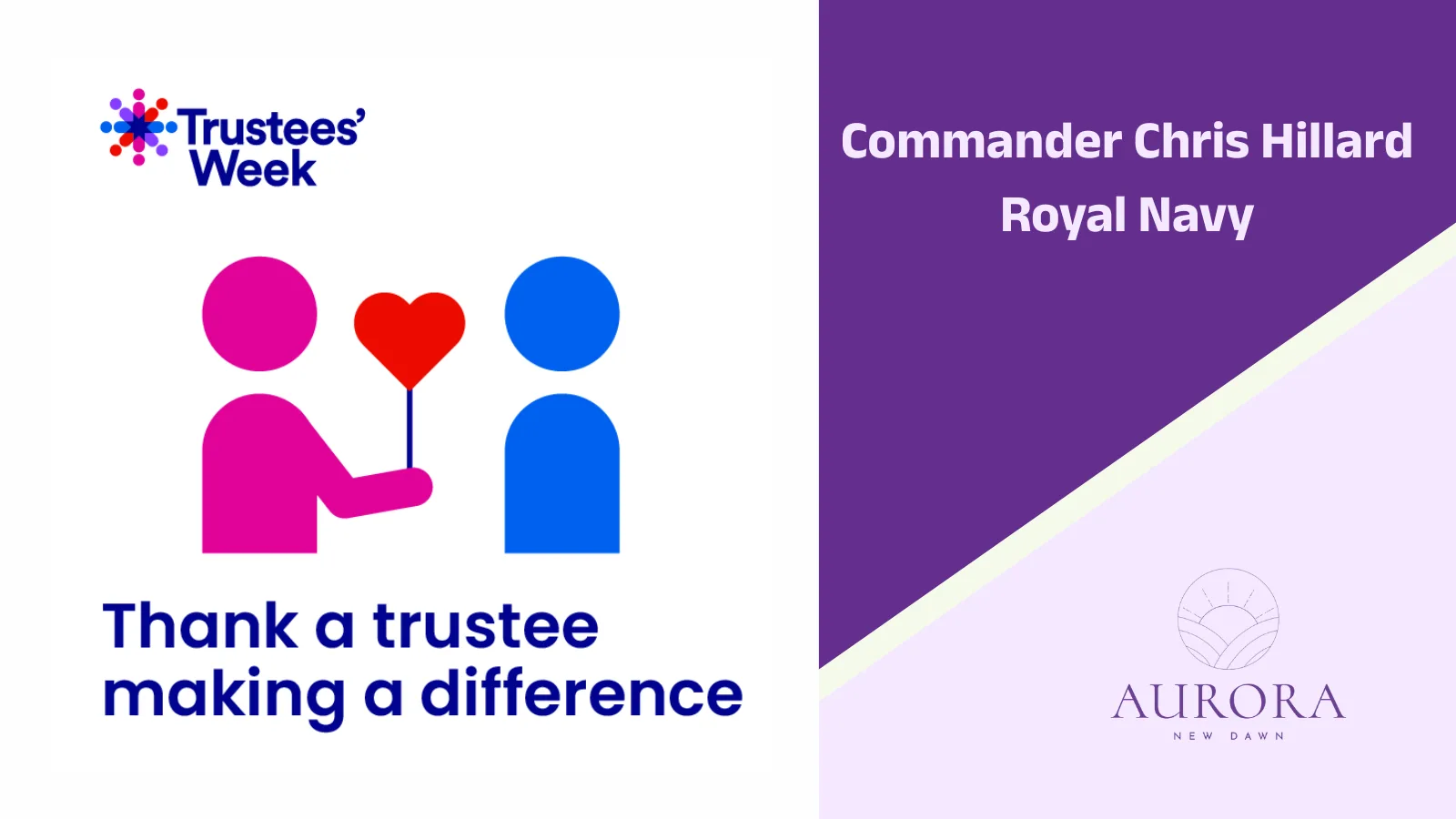
Introducing our Trustees, for Trustees Week – meet Commander Chris Hillard
From the 3rd to 7th November 2025, it’s Trustees Week and we want to celebrate the amazing contribution made by our Trustees to Aurora New Dawn. The time, commitment, and effort these fantastic people bring to our work is invaluable – we’re delighted to introduce you to some of them through this week.
First up, meet Commander Chris Hillard a Royal Navy Commissioned Officer specialising in Air Engineering
Chris has spent the majority of his 20 year career working in the joint front line operational space supporting aviation output in all environments and is currently attending the Advanced Command and Staff Course at the UK Defence Academy at Shrivenham.
What inspired you to become a Trustee for Aurora?
I was inspired to become a Trustee for Aurora for several reasons.
Firstly, as a survivor of domestic abuse I am wholly grateful to the numerous charities within the UK for what they do to both support survivors but also raise awareness of this subject.
Secondly, given Aurora is a military facing charity, I believe it is crucial for members of the UK Armed Forces to receive necessary support from a team who wholly understand what the military does, given their close ties with Defence. This means that when I work with them, there is already a major connection and empathy and understanding for what the Armed Forces do, how we operate, how we may be more at risk, and how they can support us.
Thirdly, having visited Aurora and seen the work they do I am amazed at the significant positive impact they can make with often very limited resource, but what they certainly don’t lack is enthusiasm, passion, dedication, and the desire to stand alongside those who have suffered, and these are values I wholly believe in
What’s something you’ve learned since being on the board?
Since becoming a Trustee, I have had my eyes opened wide to the sheer breadth of work that the Aurora team do. A charity must be successful across multiple domains whilst remaining wholly professional and accountable to those people it supports and the wider public.
Having personally experienced some of the administrative tasks such as Domestic Homicide Reviews that are conducted by charities like Aurora, I have a better understanding of the time and complexity it takes to complete this vital activity, but this is just a small fraction of what the charity does. I am therefore amazed by the sheer amount of output a charity such as Aurora can achieve, despite the challenges of funding and resource.
What this amazing team can deliver given their size is incredible, and offers a very humbling and inspiring experience to me.
Clare’s Law: Domestic Violence Disclosure Scheme
It has been 11 years since Clare Wood’s father, Michael Brown, won a campaign to ensure that victims were informed of any previous history of violent or abusive behaviour.
The scheme works on the premise of Right to Ask – where a victim can request information from the police on the history of their current or former partner, and Right to Know – where police can pro-actively inform people of their partner’s previous violent and abusive behaviour in order that the potential victim.
Some academics criticise the scheme[1] for placing too much emphasis on victims to make decisions to leave perpetrators after information has been disclosed about a perpetrator’s past. But victims do report positive experiences with the scheme[2]. As ever with most options it is the practicalities of applying the process which helps or hinders its effectiveness.
We asked our advocates their experience of using DVDS with victims and there were mixed reviews:
My experience of police using it is mixed, some really good and proactive but some seem to forget they can use their own authority to disclose under right to know. I’ve had to advocate for disclosures by police to other new partners that I may not be supporting – that has often been met with resistance, but I usually manage to argue its importance.
It is only convictions that are disclosed, not reports, and we all know not everything is charged for or even reported so there is a huge gap there.
I think it is very effective when it is used. I have clients who left their abusive partner after a ‘right to ask’ disclosure. I do not think that front line officers use the ‘right to know’ proactively enough and that is down to a lack of knowledge, it is still an afterthought in student training even after all these years
I think it is a great idea but like everything is not always 100%. The process for applying is consistent but is the delivery to victims consistent across the country?
A few of my clients have checked their ex-partners details would be shared under Clare’s Law. They’ve told me that it gives them reassurance that their abuser can’t hide anymore, in a sense they felt that they were protecting other women from abuse.
Police have the best platform to advise victims of Clare’s Law when attending incidents, but they rarely mention it, it should be explained as part of safeguarding.
We agree the efficacy of DVDS could be researched in more detail, but any research into the effectiveness of the scheme can only be robust if we know every police force is able to consistently offer the assurance that victims are informed and subsequently supported in a timely fashion.
The reality is resources are stretched, and training is inconsistent for new police officers across the country – whilst heave heard the benefits of the DVDS process for victim/survivors the expectation should always be that no matter what part of the country a victim is in they should receive the same response to DVDS.
The Aurora New Dawn main offices, and main office number for general enquiries, will be closed from 5pm on Thursday 17th April until 9am on Tuesday 22nd April.
The Armed Forces Helpline will be open as usual on +44 (0)333 0912 527
Available on WhatsApp chat
Easter Sunday 1000 – 1400
Easter Monday 0900 – 1500
Open by phone
Good Friday 0900 – 1500
Easter Monday 0900 – 1500
In any emergency call 999.
We wish you all a Happy Easter, and a happy long weekend if you are taking a break.
Armed Forces Helpline Now Live
We are delighted to share that our new Armed Forces Helpline for survivors of domestic abuse, sexual violence, and stalking is now live.
This Helpline is for any members of the Royal Navy, British Army, and Royal Air Force, and their family members, including those deployed abroad, who are victims and survivors of Domestic Abuse, Sexual Violence or Stalking.
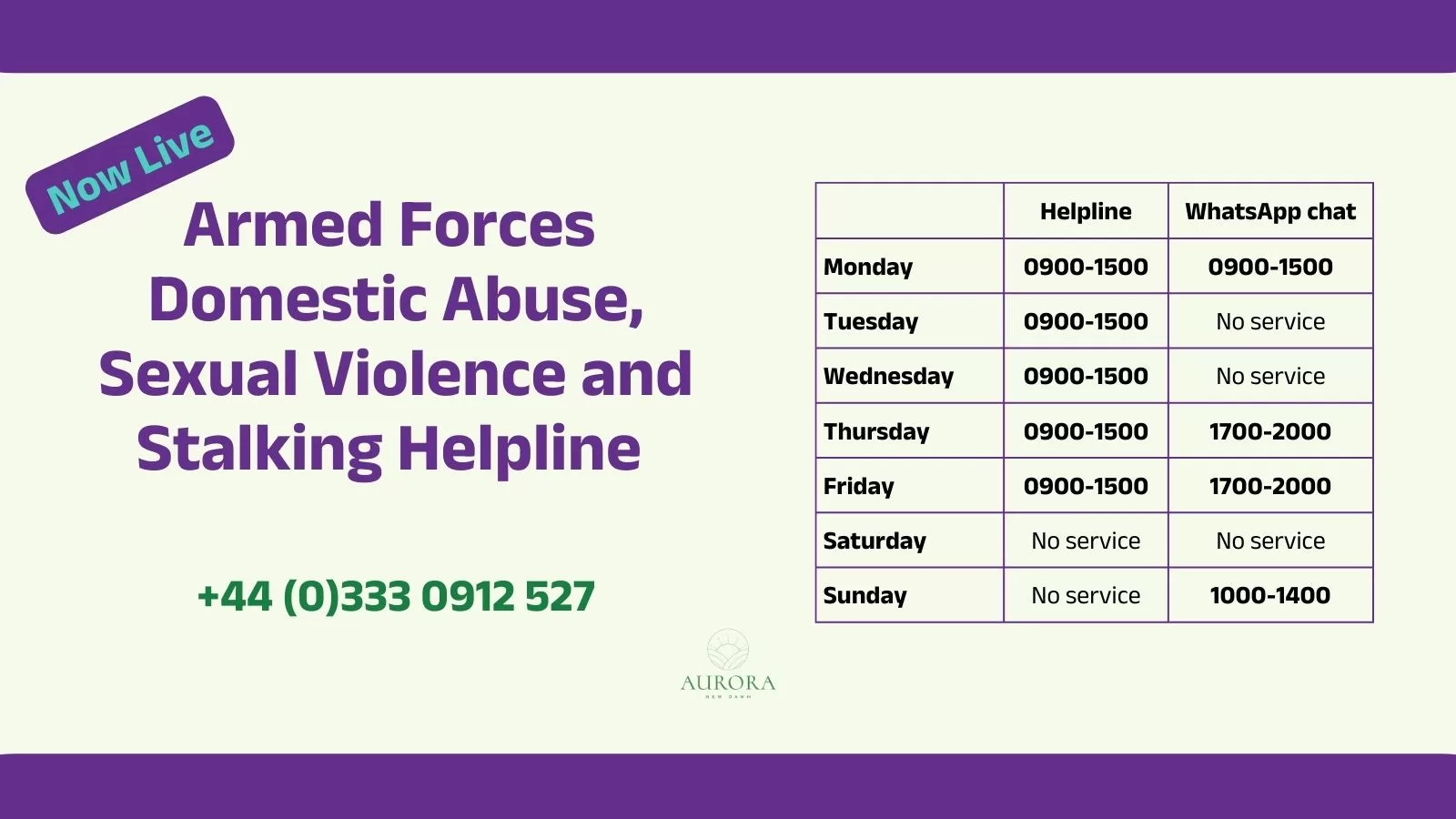
The Helpline operates 6 days a week. It is independent, confidential, and free, and having consulted with victim/survivors we have made sure to be available at different times.
At Aurora, we understand that the Armed Forces Community is unique, and we know that service life brings with it a number of challenges which can make it harder to talk about these issues.
The Helpline has been designed with an understanding of these specific needs in mind. Many of our specialist team are from Forces families or are ex service personnel. They understand service life, and how difficult it can be to talk about what is happening.
Those who choose to perpetrate Domestic abuse, sexual violence and stalking come from all walks of life. We want to make sure that victim/survivors with links to the armed forces get specialist support that has been designed with them and for them.
For general and professional enquiries, to contact the team, or for information on how to refer to the service call 023 92 479 254 or email us.
Need help?
Get support from the Armed Forces Helpline via phone +44 (0)333 0912 527 (GMT): 0900-1500 Monday to Friday
Get support from the Armed Forces Helpline via WhatsApp on +44 (0)333 0912 527: Monday 0900-1500 / Wednesday & Thursday 1700-2000 / Sunday 1000-1400