Blog – Stalking Awareness Week Round-Up

This year’s has been an exceptionally inspirational stalking awareness week and we are so pleased that there is an increase in attention and knowledge on stranger and cyber stalking.

We have a few favourite articles from across the week that we thought we’d share with you.

Lily Allen’s story of surviving stalking has, quite rightly, dominated the week, raising public awareness of risk, the experience of fear and the importance of joined up police response. This article, on the difference between a fan and a stalker, is really informative and gives an overview of the different typologies of stalkers used within the Stalking Risk Profile, which is the model we use in Hampshire.

The Suzy Lamplugh Trust’s report Out of Sight, Out of Mind outlined the importance of police and crime commissioners’ roles in improving the police response to stalking (and named the Hampshire PCC funding of the stalking clinic as an excellent example of good practice).

Then there was the launch of the campaign from Women’s Equality Party and Paladin to join the dots in stalking cases.

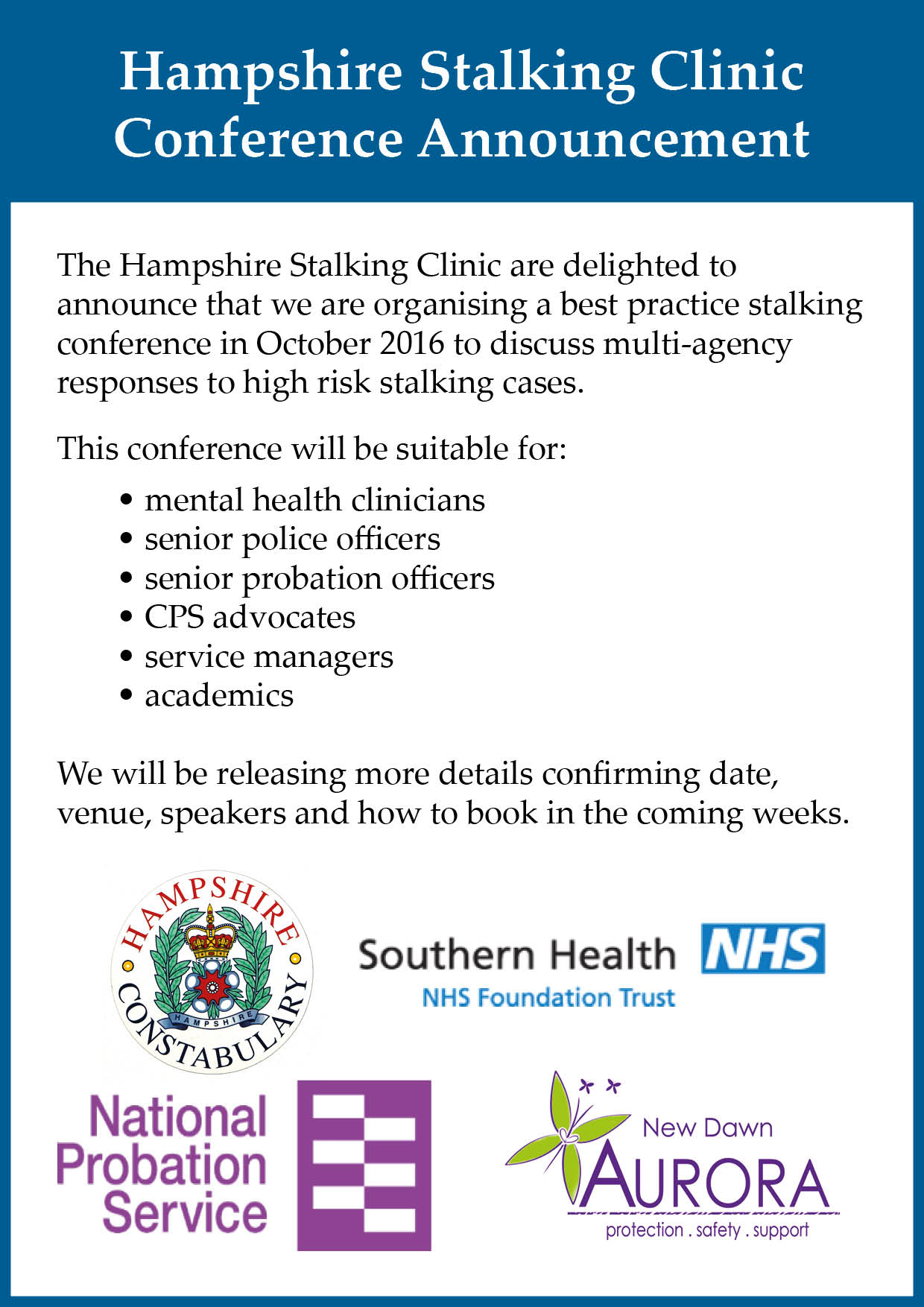
And, of course, my very favourite was this announcement from the Hampshire Stalking Clinic. We will be releasing more information soon, with details of speakers and how to book.

Stalking Conference

The Impact of Persistent Stalking

What is Persistent Stalking?

Persistent stalking has a devastating effect on the people who experience it. By no means should we dismiss stalking behaviour as simply persistence. Whilst the risks of violence in stalking cases are well known, and rightly so, the risks of persistent stalking are no less impactful.

Persistent stalking, whether or not there is no fear or threat of violence can lead to victims feeling trapped, isolated and hyper-vigilant. Many of the clients that we work with at Aurora talk about feeling paranoid and as if they are just waiting for the stalker to be seen or act again. When someone is feeling this level of psychological torment and feel sure that it will never end, anything can trigger a fear response. There doesn’t need to be a threat or fear of violence for someone to feel utterly terrified. Furthermore, victims of stalking over long periods of time can report feeling numb or bored of what they’re going through, as if they are a burden on their friends and family, whom they talk to about their experiences, and often choose not to report to the police because they feel that they are wasting police time. The latter seems to happen most in cases where the stalking has previously been no further actioned.

The 4a Stalking Charge

The 4a stalking charge that criminalises a course of conduct which causes ‘serious alarm or distress’ and has ‘a substantial adverse effect on the day to day activities of the victim’ seeks to capture the psychological and emotional harm that victims of stalking experience.

The list includes:

  1. the victim changing their routes to work, work patterns, or employment;
  2. the victim arranging for friends or family to pick up children from school (to avoid contact with the stalker);
  3. the victim putting in place additional security measures in their home;
  4. the victim moving home;
  5. physical or mental ill-health;
  6. the deterioration in the victim’s performance at work due to stress;
  7. the victim stopping /or changing the way they socialise.

woman being persistently stalked

The long-lasting nature of persistent stalking

This list is by no way exhaustive and, I would argue, does not begin to address the long-lasting nature of the impact of stalking, which can have devastating effects on relationships and trust for years. This impact is frequently not captured by the initial or investigating officer because, so often, stalking appears as a series of bizarre and often unconnected incidents. Encouraging officers to look at the fixation and obsession that drives the varied behaviour is one of our objectives through the Hampshire Stalking Clinic.

We hope you’re finding the blogs throughout 2016 useful or interesting. If you have any questions, or would like to contact anyone about stalking please call us on 02392 479 254 (office hours) or 02392 472 165 (out of hours). For national enquiries, call the Paladin helpline on 07769995393 or the National Stalking Helpline on 0808 802 0300.

Next step…

Do you want to get in touch with us?

Want to know more about our stalking service?

Want to donate to our cause? 💜

Blog Post – Cyber Safety

Cyber stalking is, in a nutshell, the use of technology to gather personal information, track and monitor.

Examples of some behaviours include using social media to research someone’s movements and/or networks, gaining access to someone’s emails, devices or networks, uploading spyware or malware of some kind, placing a tracker on someone’s car, using equipment to record someone’s conversations. Cyber stalking also includes gaining access to someone’s accounts or devices to delete evidence (for example if someone is keeping a log of harassment on their phone or computer, or if the stalker has sent emails that would count as evidence).

Some cyber stalking behaviours have a threatening and/or vengeful dynamic, for example ‘revenge porn’, doxing and the stalker creating fake profiles as the victim with the intention of damaging their reputation.

Cyber stalking is an area of increasing research and knowledge. Last week the Suzy Lamplugh Trust released results from their recent survey into cyberstalking. Out of the 4,054 British adults polled they found that:

  • People between the ages of 18 and 34 are significantly more likely to have been stalked online
  • Where online activity was the sole form of stalking behaviour, only 9.8% of victims reported it to the police.
  • Over a quarter of victims (28.3%) felt concerned about going out in public and 20.4% reduced their social outings, while 18.6% changed their phone number, one in 10 (9.5%) moved home and 8.7% increased security at home or work.

More findings and information can be found here. The College of Policing response to the findings is here and you can follow Suzy Lamplugh Trust on twitter here.

Whilst we cannot stop cyberstalkers, we can make it harder for them to gain access to, monitor or intercept data. The following is a list of options available to increase online security:

        • Come up with a handful of aliases you can use to set up accounts and email
        • Use avatars or profile pictures with images other than you on social media
        • Search for yourself online from time to time to see what’s available about you
        • Check out whether data is leaking from any of your social media accounts using mypermissions.com
        • Select the restricted electoral roll to prevent your personal data being sold to companies such as 192.com
        • Read privacy statements (they’re boring, but worth it) and go through your account settings every now and again to do a privacy check up
        • Use two factor authentification, where possible, to increase account login security
        • Download the Tor browser for going online, or HTTPS Everywhere to increase browsing security
        • Keep your apps, browsers and programmes up to date with the latest versions (this will be offered automatically), as older versions are more vulnerable to attack
        • Use different emails for different things. You can easily create a disposable email using mailnull.com
        • Email is pretty insecure, you can encrypt it yourself or use a service such as hushmail or protonmail
        • Text messaging is also insecure – Whatsapp is now end-to-end encrypted and Signal is an app that encrypts text messages and phone calls.
        • Get yourself a password manager – LastPass is fantastic


If there are software or apps you use to stay safe online let us know on Twitter @AuroraNewDawn, Facebook, or in the comments below.

You can find more information out about cyber security at GetSafeOnline.org.

Blog Post – Hampshire Stalking Advocacy Service

Our Independent Stalking Advocacy Service was established in 2013 following the change in the law in 2012. This service is part of the Hampshire Stalking Clinic, a multi-agency forum that meets once a month to discuss the four stalking cases in the county that raise the highest level of concern. The clinic is made up of two senior police officers, the three police single points of contact (SPOC) for stalking across Hampshire, two probation officers, a forensic psychiatrist, a forensic psychologist, a CPS lawyer and Aurora’s independent stalking advocate (ISAC). The clinic’s focus is to assess the risk presented by the stalker, offer advice to involved professionals and offer support to those experiencing stalking.

Alongside working with survivors of stalking and supporting the work of the clinic across Hampshire, our advocate advises professionals working on stalking cases on the safety options available. The service offers support and advice to all genders for all dynamics of stalking.

A day in the life of Aurora’s Stalking Advocacy Service

The coffee is on and the phone rings, it’s an IDVA who is supporting someone whose case has been heard at the stalking clinic. The client is being stalking by an ex-partner, there are bail conditions in place and the stalker is skirting around the boundaries of them. The IDVA and the ISAC are in regular contact about this matter and, as a result of the conversation, the ISAC takes an action to speak with the SPOC for the area to alert her to the ongoing behaviour. On speaking with the SPOC, another case is raised as a concern and the ISAC takes the details of the investigating officer to contact and discuss the case. The officer talks through the case and takes the details of the advocacy service to offer support to the survivor on their next contact.

The advocate checks through her emails to prioritise her work for the rest of the day, there are two new referrals and a request for contact from a social worker. The referrals are entered into the secure database and contact is made with the survivors. The first client is with a police officer and writing their victim personal statement for a court case next month, they would like support through court so they arrange to speak tomorrow morning. The second person is available, they are experiencing stalking from someone they used to work with. The stalking screening tools are completed and there is a medium level of concern but with some escalation in the past week. The contacting behaviours have changed from the stalker setting up fake Facebook profiles to attempt contact to the stalker being at the workplace when the client turns up for work. Log keeping is advised, the client does not want to report to the police at the moment, preferring to see if it can be managed through their employer for the time being. A safety and support plan is agreed and they arrange to meet in a couple of days.

The social worker would like advice on how to proceed with a case where there are concerns about someone making applications to the civil court around the child in order to be in the same room as the client. The client doesn’t want any other services involved at the moment, because it would be too much. The ISAC offers advice on how to increase the support around the client and make the judge aware of the dynamics of stalking in the social care court report.

Over lunch the ISAC meets with a colleague to talk through advice that can be given to clients to increase their online safety. She then heads off to meet with a colleague from the Hampshire Stalking Clinic to discuss an upcoming presentation to police investigators as part of a safeguarding day.

On returning to the office, the ISAC makes sure all urgent queries that came in whilst she was out are answered and makes calls to the clients whose cases will be presented at the stalking clinic later on in the week. Whilst clients are unable to attend the meeting, the ISAC can make sure that their voice and experiences are represented to the professionals there, as this will inform the risk that the stalker presents and what work we can do as a result of the clinic.

If you live in Hampshire and are experiencing stalking, we are available from 9am-5pm throughout Stalking Awareness Week on 02392 479 254. For national enquiries, call the Paladin helpline on 07721757071 and 07769995393 or the National Stalking Helpline on 0808 802 0300.

Aurora’s Independent Stalking Advocate has an MSc in Criminology and Criminal Justice and worked for three years as an IDVA before taking on the stalking work. She has completed AVA’s accredited Stella Project training, Safelives’ accredited IDVA training, Paladin’s accredited ISAC training and training in the Stalking Risk Profile, for the assessment and management of stalkers.

Aurora’s Stalking Advocacy Service is funded until April 2017, as part of the Stalking Clinic, by the Office of the Police and Crime Commissioner.

Blog post – Specialist Domestic Abuse Court Independent Domestic Violence Advocate

SDAC blog post:

Our Specialist Domestic Abuse Court Independent Domestic Violence Advocate (SDAC IDVA for short!) works with victims and survivors of domestic abuse whose cases are going through the criminal justice system.

Court cases can take time, and the criminal justice process can be a complex and often incredibly frightening experience for victims of domestic abuse in particular. We know that nationally the conviction rate for domestic abuse cases is around 13%. Many victims and survivors feel unable to continue with the process: as a result of fear, risk, pressure, or a lack of support. Often these fears can be exacerbated by long wait times between charge and trial. As such the attrition rate in domestic abuse cases – the rate at which witnesses drop out of the criminal justice system – is very high.

Portsmouth has what is known as a Specialist Domestic Abuse Court or SDAC. These courts – sometimes called Specialist Domestic Violence Courts (or SDVCs) – exist in various areas across the country to respond to the specific needs of victims of abuse and support them in being able to give their evidence. Rather than being separate buildings, the term SDAC refers to a set of processes and facilities that a court has in place to ensure domestic abuse cases are dealt with quickly and efficiently, and that victims have access to information and support at every stage of the process.

A key component of any SDAC court is the availability of independent, specialist support for the victim, and this is where our Specialist Court Advocate comes in, offering specialist, one-to-one support to anyone whose case is going through court. All the usual elements of an IDVA service are provided, including risk assessment, safety planning, advocacy/liaison with other agencies and emotional support, but with the added component of direct support for the duration of the court case. This will vary depending on the needs of the client but might involve:

  • Ensuring the client is kept up to date with the status of the case
  • Ensuring that their safety during the hearing (both on entrance/exit and in the courtroom) is prioritised
  • Liaising with the police/CPS to make sure that restraining orders are both applied for where required, and robust and detailed enough to effectively protect the victim going forward
  • Remaining in court until the conclusion of the case (to ensure the client is updated on the outcome as quickly as possible)
  • Attending sentencing on the client’s behalf
  • Working with SDAC court partners to ensure the process is kept under continuous review, and to feedback about both good practice or areas for improvement.


The aim of the SDAC court, and the specialist advocate, is to ensure that victims and witnesses are kept central to the process at all times. By offering independent support throughout, the hope is that victims feel supported, safeguarded, and therefore more able to continue their involvement with the court case. The service’s key aim is to contribute to the reduction of the high attrition rate for domestic abuse cases in the city.

Outcomes:

In our most recent analysis of the service, none of the clients who engaged with the SDAC IDVA have withdrawn from the CJS process. Whilst some cases have been discontinued for other reasons, the attrition rates for clients working with the SDAC IDVA remain low. In asking clients for their feedback on the service, 100% of the clients who have completed evaluation forms said that they felt supported at court as a result of working with the SDAC IDVA. 100% reported that they felt their emotional wellbeing had improved as a result of working with the SDAC IDVA, and 80% reported that they felt safer as a direct result of engaging with the service.

Interestingly, we saw early guilty pleas in 71% of the cases involved with the SDAC IDVA in the last reporting quarter. In an early guilty plea, the perpetrator pleads guilty before the trial rather than at the trial itself, which is of particular benefit because it negates the need for victims to attend court and give their evidence. Sometimes defendants will avoid making an early guilty plea in an attempt to ‘wait it out’ hoping that the victim will not attend court. An increase in early guilty pleas may point to a growing recognition, amongst defendants and their representatives, that victims are feeling increasingly confident in continuing with the criminal justice process. We continue to work with our partner agencies, including the police, CPS, witness service, and court staff, to track the impact of the Specialist court, and of the Independent advocate, going forward.

The following is an example, from our Specialist Court Advocate, of the work they undertook at court with a client recently:

Case study from SDAC IDVA:

I meet my client away from the court building, as she has never been to court before, she is understandably very nervous. We are there for a trial as my client’s perpetrator pleaded ‘not guilty’ to an assault against her. We head towards the courts together, where the court staff sign us in as we enter and we are collected by a member of the witness service. We are escorted to a secure area and I reassure my client that we are in a safe space, away from the perpetrator and the public areas of the court. The witness service volunteer explains the court procedure to my client and I reassure my client that a screen is in place for when they give their evidence as they do not want to be seen by him. My client and I have a coffee whilst waiting. The prosecutor then comes and has a chat with my client about what to expect and hands them their statement to read.

I leave my client to read her statement and offer to clarify anything if they find it difficult to read. I encourage my client to read their statement again, or as many times as they like, to make sure they aware of what is written. I then take instructions from my client as to whether or not they would like me to leave with them, once they have given their evidence, or if they would like me to remain in the court to observe the rest of the trial. My client opts for me to stay in the court room to observe the rest of the trial. I reassure my client that a witness service volunteer will escort them into the courtroom, will sit with them behind the screen when they are giving their evidence and will escort them safely out of the building once they have given their evidence.

My client is called to the courtroom to give her evidence. The courtroom is emptied whilst my client is taken in and placed behind the screen. I go into the courtroom and sit in the public gallery at the back. The perpetrator is then brought in and my client gives her evidence. She is then free to go. The courtroom is emptied again whilst my client is taken out of the courtroom, by which time I say goodbye and agree to call them after the trial has ended. The Perpetrator then gives his evidence. The evidence for the prosecution’s case is strong enough to prove, beyond reasonable doubt, that the perpetrator assaulted my client and the magistrates decide that perpetrator is ‘guilty’. The sentencing hearing is adjourned for 3 weeks, pending a pre-sentence report from Probation and bail conditions remain in place until then. Perpetrator is free to leave and, for the purpose of safety and confidentiality, I leave making sure that it is either before or after the perpetrator has left.

Once out of the court I call my client immediately and relay the outcome. I provide emotional support as my client reflects on their thoughts and feelings. This has been a very emotional time for her. I remind her that she has been incredibly brave in speaking out and we talk through the importance of her taking things easy for the rest of the day. I remind her to call me if she wants to talk further or has any questions. In closing I reassure my client that a restraining order has been applied for, but that bail conditions will remain in place until the sentencing hearing. We agree that I will attend the sentencing hearing without her (she is not required to attend), and that I will update her of the outcome as soon as I have it.

 *This project is funded by the Police and Crime Commissioner for Hampshire and the IOW*

Aurora New Dawn awarded national accreditation

Aurora New Dawn have become the first voluntary sector organisation in Hampshire to be awarded Leading Lights accreditation by the national agency Co-Ordinated Action Against Domestic Abuse (CAADA) for work with victims and survivors of domestic abuse.

What is the award?

The award recognises the contribution of Aurora’s Independent Domestic Violence Advisors (known as IDVAs), who work with victims at high risk of serious harm or murder. Advisors work closely with victims and other services, such as police, social services and housing, to reduce the risk of harm to survivors and their children.

CAADA’s Leading Lights accreditation is the national and highest mark of quality for domestic abuse services. The status recognises that Aurora IDVAs provide a gold-standard, safety-focused service at every level that puts victim and survivors at the heart of the organisation’s work.

Aurora New Dawn is only the 39th service to be accredited in the UK, just 3 years after the service’s inception. The process of accreditation takes around 12 months, and involves the separate assessment and accreditation of the service manager, the submission of an extensive evidence dossier and, finally, an assessment visit from the CAADA Leading Lights Team.

Zoe Jackson, Operations Manager said:

“We are incredibly proud to have achieved Leading Lights Status, particularly within just 3 years of us starting out. The status reflects the high standards we expect from our service and is a real credit to the incredible work of our frontline staff. Our team are working closely with clients every day and the assessment process looked at every aspect of their work, including complete scrutiny of our case files, risk assessment, safety planning, advocacy and beyond.

We are also delighted to be specifically recognised for seeking regular feedback from all who use our service and incorporating their experiences into the ongoing development of our organisation. In the last 9 months 100% of our clients have told us they feel safer as a direct result of working with our IDVAs and it’s fantastic to see that work recognised.”

CEO Shonagh Dillon said:

“The whole team and I are so thrilled about being awarded Leading Lights status. Survivors of domestic abuse, sexual violence and stalking have always been at the centre of our practice and we are committed to continuing this as the organisation grows. It’s really gratifying to our frontline team to receive such a commendation of their work at a time of such great financial challenge for domestic violence services, particularly as Leading Lights status will help us to attract funding in the future.

“The accreditation will definitely help us to keep working closely with victims and survivors in Hampshire, to keep improving our services and to increase the safety of the many families who suffer in silence every day as a result of domestic abuse. We’re very grateful to CAADA for their guidance and support and we’re very excited to continue our work with them in the future.”

The Chair of the Internal Accreditation Panel said:  

‘We’re delighted to have awarded Leading Lights status to Aurora New Dawn. What came through during the assessment process was a firm commitment from the team to get it right first time for victims of abuse. We were pleased with their determination to use data to learn and improve, setting and achieving really high standards of support.’

Hot Coals Fundraiser

UPDATE: We raised just over £7K for victims and survivors of domestic abuse, sexual violence and stalking. Aurora would like to extend our thanks to all who walked, donated and raised awareness on the night.

Victims of domestic abuse walk on hot coals every day in fear of aggression and violence from perpetrators. On November 28th 2014, Aurora New Dawn staff and supporters will be undertaking a challenge to walk on hot coals to raise money for victims and survivors of domestic abuse.

Shonagh Dillon, Chief Executive of Aurora New Dawn is taking the challenge along with several members of the team.

She said, “For the last 5 years, we’ve run the Reclaim the Night March in Portsmouth to raise awareness of violence against women in Portsmouth and the surrounding area. This year we wanted to do something different.

“We decided to undertake the Hot Coals challenge to highlight the daily experience of victims of domestic violence and their families, who walk on hot coals every day with the threat of violence to keep themselves safe and avoid harm.

“At the same time, we’ll be raising money for the White Ribbon campaign, which brings men and women together in the struggle to end violence against women.”

The campaign urges people to take the White Ribbon pledgenever to commit, condone, or remain silent about men’s violence against women in all its forms.

You can sponsor Shonagh via Just Giving or share the link with your friends and spread the word.

To find out more about supporting White Ribbon and Aurora New Dawn, or about the Hot Coals challenge, email us at info@aurorand.org.uk

Not for Sale – Council rejects lap-dancing club application in Portsmouth

Aurora New Dawn was proud to be among a group of 7 deputations made to Portsmouth City Council concerning the relocation of lap-dancing club Elegance to a property on Albert Road.

The Council’s Planning Committee voted unanimously to reject the application from local lap-dancing club owner, Paul Ojla.

We have a number of reasons why we object to the application.

First and foremost, Aurora New Dawn supports the women’s bodies are not a commodity to be bought and sold, acknowledging the United Nations’ Convention to Eliminate Discrimination Against Women (CEDAW), which calls on the government to reduce the objectification of women to advance gender equality.

This requirement was highlighted by remarks from the UN Special Rapporteur earlier this year, who said there was “a more visible presence of sexist portrayals of women and girls” and a “marketisation of women’s and girls’ bodies” in the UK, which was more pervasive than elsewhere.

The Gender Equality Duty (2007) places a legal obligation on Portsmouth City Council to ensure that their decisions do not have a negative impact on women’s equality and require the Council to actively promote gender equality and to work towards countering gender stereotypes.

Lap-dancing is an industry staffed almost exclusively by women for male clientele, so the Council’s policy on lap-dancing falls under the Duty. Recognition of the gendered nature of the industry played a role in the campaign for the Council to introduce an SEV Policy for the city, which was passed in 2012.

The SEV Policy commits the Council to a ‘Nil Cap’ on any further lap-dancing clubs in the city. While Elegance has a license for its premises in Granada Road, as SEV licenses are non-transferable, re-locating the club would trigger the Council’s nil cap policy.

The proposed site is immediately adjacent to the Wedgewood Rooms, a nationally well known and popular performance venue attracting large numbers of young people, including under 16s, making it wholly inappropriate as a location for a sexual entertainment venue (SEV).

Although the decision was made unanimously and supported by a local campaign led by councillors, Mr Ojla is entitled to appeal the decision.

Speaking about the appeal, Shonagh Dillon, Chief Executive of Aurora New Dawn, “We’re delighted that the local campaign against the move has been so successful.

“If Mr Ojla decides to appeal, we look forward to campaigning again to uphold the decision, and ensuring that Portsmouth City Council keeps its own SEV licensing policy, approved in 2012.”

Aurora was an active partner in the campaign to introduce the SEV policy, alongside the Solent Feminist Network and local residents.

Aurora’s Christmas Fundraising Appeal

At Christmas and New Year, the number of domestic and sexual violence incidents goes up.

Unfortunately, funding for the services that help victims doesn’t.

Aurora New Dawn is a charity that will be working hard for victims and survivors throughout the holidays. If you’d like to help us do this, there are a number of ways you can support our work.

DONATE BY TEXT

Donating just £3, £5, £10 or even more will help to bring safety and support to victims and families when they need it most.

Simply text RFAV27 followed by the amount you want to donate to 70070

DONATE AS YOU SHOP

Now you can help Aurora New Dawn as you do your Christmas shopping online.

Shop with your favourite stores this Christmas and they’ll donate to us – without charging you a penny more.

All you need to do is join and install Give as you Live.

Start raising funds now by clicking on this link –  http://www.giveasyoulive.com/join/aurora-new-dawn/ct53754

And here’s what happens next…

1. Visit the website and click “Get started”.

2. Fill in a quick few details. Your information is safe.

3. Install Give as you Live. This is 100% secure and takes seconds.

Watch this ‘how it works’ video to learn more about Give as you Live – http://www.giveasyoulive.com/howitworks

Every time you shop online you can raise money for AURORA NEW DAWN – without putting your hand deeper into your pocket.

And if you can’t spare any money, why not help by sharing this page on Facebook or Twitter?


© Everyclick Ltd and AURORA NEW DAWN, 2013. All rights reserved.
Everyclick is a company registered in England and Wales. Company number 5181419
Registered address: Basepoint Business Centre, Crab Apple Way, Vale Business Park, Evesham, Worcestershire, WR11 1GP.


An open letter to Nigella Lawson

Dear Nigella,

We wanted to send you this open letter to express our support and admiration for you at the end of a difficult week. We also want to let victims and survivors know that no one has to go through the experience of violence or abuse alone.

We have no way of knowing the details of your marriage – nor should we, it’s nobody’s business but yours – but as a service working with victims of domestic abuse, there are many things about your experiences during this week’s trial that were very familiar to us, particularly in light of the shocking photographs in the media this summer.

This week you described parts of your relationship as resembling ‘intimate terrorism’. This phrase perfectly captures the coercive and controlling behaviour exhibited by many perpetrators. For many victims of domestic abuse, violence is only one element of this control, which can also include limiting a partner’s social contact with others, extreme possessiveness, and portraying the victim as somehow being the ‘cause’ of the violence enacted against them.

Of course, we know this isn’t true. While many perpetrators of abuse and violence exhibit ‘uncontrollable’ anger towards their victims, most also possess the self control not to extend the same rage or violence towards others. In fact, this can be one of the many ways in which perpetrators seek to persuade victims that the abuse is actually their own fault.

We also know that it takes incredible strength to leave an abusive relationship. But unfortunately, even when abusive relationships end, the abuse often doesn’t.

Every day, we see perpetrators who will use any means at their disposal to continue their pattern of coercion and control. Leaving the relationship does not stop the abuse, it often exacerbates it, leaving victims and survivors at their most vulnerable.

Even when perpetrators admit abuse – as Mr Saatchi did when he accepted a police caution for common assault this summer – many will still claim to be the victims of violence or abuse themselves. It is not uncommon for perpetrators to attempt to mask the truth of their own behaviour by expressing concern for their victim while smearing their name with allegations of bad parenting or drug-taking, for example.

Some victims use drugs or alcohol as a way of coping with violent and abusive behaviour. Such drug use often ends when the victim is free from the relationship and safe, because this coping mechanism is no longer needed.

By speaking out this week about your experiences, you show women everywhere that an abusive relationship can happen to any woman, at any time. You have also shown that victims can leave abusive relationships when they are ready, with the help and support of friends, family or supporting services.

Your strength and dignity show all victims and survivors that they are not alone, and like you, they can move on to a new and better life. For this we cannot thank you enough and we are proud to be part of #TeamNigella.

Yours, with much admiration,

The Aurora New Dawn Team


At Christmas and New Year, the number of domestic and sexual violence incidents goes up. Unfortunately, funding for the services that help victims doesn’t. If you can spare £3, £5, £10 or even more to support Aurora New Dawn, a local charity that will be working hard for local victims and survivors throughout the holidays, you will help to bring safety and support to victims and families when they need it most.

Simply text RFAV27 followed by the amount you want to donate to 70070

And if you can’t spare any money, why not help by sharing this page on Facebook or Twitter.


[1] BBC News online, Rise in convictions for violence against women, 2012, http://www.bbc.co.uk/news/uk-18949533

Aurora Shop

The Aurora New Dawn merchandise shop launches soon! Check back regularly for updates.

Website by Storytellers Australia

Copyright © Aurora New Dawn. All rights reserved | Registered Charity No 1153154 | Legal Notice: Content on this site is subject to a disclaimer and a copyright notice. Site implemented and maintained by Aurora New Dawn | Text: Sarah Louise Cheverton