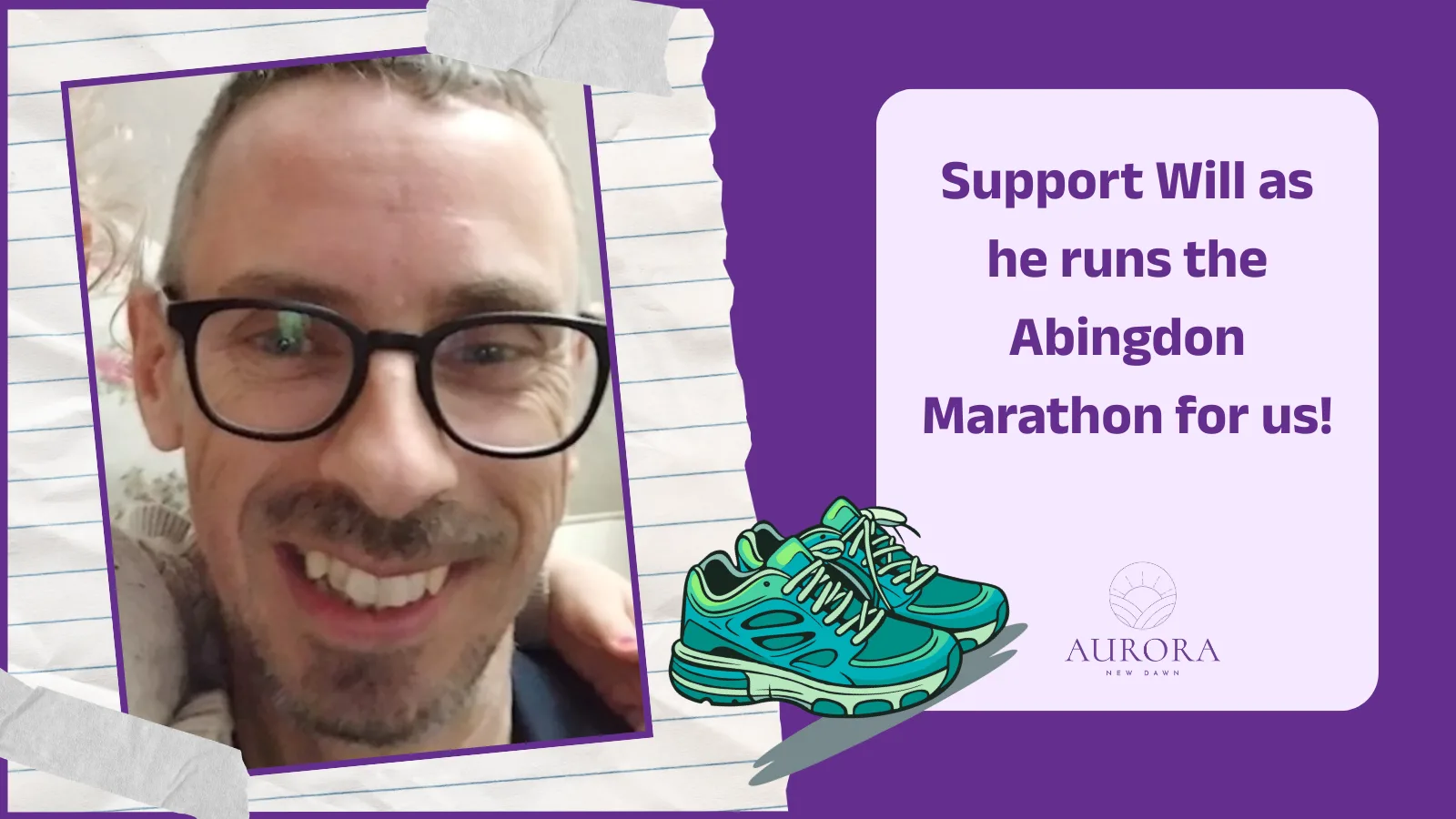
Support Will as he runs the Abingdon Marathon for Aurora New Dawn!
HUGE thanks to Will who will be running in the Abingdon Marathon in October to help raise funds for us!
“It is shocking and sobering that one in four women in the UK experience domestic abuse in their lifetime.
Aurora New Dawn is a great charity that supports survivors of domestic abuse, sexual violence and stalking. I’m running the Abingdon Marathon in October to help raise funds for them and I would be thrilled if you were able to support them too. Thank you!”
Following the publication of the Government’s Violence Against Women and Girls (VAWG) Strategy in December 2025, we have taken time to fully review and reflect on its contents. While the true measure of success will lie in its implementation – supported by consistent review, scrutiny, and accountability – we believe it is important to share our initial response.
We echo our colleagues at Women’s Aid in welcoming the overall ambition of the strategy. We are pleased to see a strong emphasis on prevention, alongside a clear commitment to the relentless pursuit of perpetrators. The proposed reforms to commissioning processes are long overdue, and we welcome opportunities to contribute to local and national discussions on how these systems can better serve victims and survivors in a holistic and trauma-informed way.
Despite this, significant gaps remain. We are especially concerned that some victims and survivors, particularly Black and minoritised women, continue to face discrimination due to the absence of adequate safeguards. In this regard, we wholeheartedly support the statement issued by Southall Black Sisters.
While we are encouraged that stalking is explicitly recognised within the strategy, we are disappointed that the Government has missed the opportunity to include all forms of men’s violence against women and girls. As highlighted by our colleagues at the Femicide Census, exploitation of women through prostitution is notably absent. Furthermore, as noted by the Femicide Census, the strategy provides insufficient focus on those with multiple and complex needs, as well as older and disabled women.
We are, however, particularly pleased to see the Government acknowledge the importance of strategic work within Armed Forces communities. When we began developing bespoke services for Armed Forces communities nine years ago, there was minimal national attention given to the unique barriers faced by victims and survivors within these settings. At that time, it felt unimaginable that a national VAWG strategy would not only recognise their needs but also confront the dynamics of power that perpetrators in these communities often exploit.
We are proud to be named in the strategy and pleased that our international Armed Forces helpline and WhatsApp service has been highlighted. Since launching our services nine years ago, our aim has been to create accessible, specialist support that responds directly to the unique experiences of victims and survivors in Armed Forces communities. We remain deeply grateful to our funders; however, it is important to note that our helpline – referenced in the strategy – is currently a two-year pilot, with funding due to end in March 2027.
Although we are committed to securing the continuation of this vital resource, it would be remiss of us not to highlight that we were not consulted during the development of the strategy. While we are proud to be included, having a seat at the table would have ensured that we highlighted that we are one of many small, specialist, independent organisations delivering innovative “by and for” services nationwide. We are pleased that our specific model with the Armed Forces has been recognised, but true recognition must be matched with long-term, sustainable funding for the specialist independent sector. Without this, services will close, and strategies, however ambitious, will fail to deliver for victims and survivors.
Dr Shonagh Dillon LLB, DCrimJ
CEO – Aurora New Dawn
#16Days: A Day in the Life of an Armed Forces Advocate
My day always begins with coffee. Not just any coffee—freshly ground and strong! It’s my routine as I open my laptop and prepare to dive into the day. Of course, the real start happens earlier: breakfast, lunch boxes, and a bit of reluctant exercise. But coffee marks the beginning of my workday.
First stop: emails. Overnight, there might be new referrals from our Armed Forces helpline or updates from professionals we collaborate with. Today, I’ve received a message from a victim liaison officer—there’s a court date set for one of my clients. I’ll reach out to them to offer support and talk through any concerns they might have.
Next, I make check-in calls. Each client is on a unique journey, and our support adapts to their needs. One has just moved into a new home and started a job—her children are thriving, and we chat about their weekend plans. Another needs legal advice around a child arrangement order, so I book her a pro-bono consultation with a brilliant team that supports survivors of domestic abuse.
Then there’s a client who simply needs someone to talk to today. Things feel heavy. We’re here to listen first and foremost.
A new referral has come in. I take a moment to prepare before reaching out. These first conversations are delicate. It takes immense courage to ask for help, and I honour that by moving at their pace. Sometimes urgent safety measures are needed, and once those are in place, we plan the next steps together.
The morning flies by. Over lunch, I dial into a lunch and learn session—an opportunity to grow, share best practices, and stay abreast of policy changes.
After a cup of tea (of course), I’m off to deliver a short presentation to Armed Forces representatives. I love promoting our services—it’s exciting to be part of a movement that’s changing how victims are supported.
Back at my desk, I find a reply from a charity helping one of our clients furnish her new house after fleeing a dangerous home. Then a call comes in: a client needs refuge space. I act quickly, locating available spaces and making the necessary referrals. This role is dynamic—plans shift, and we respond where we’re needed most.
My final call of the day is with someone who’s ready to move on. She’s joining one of our recovery groups and no longer needs advocacy support. We go over safety advice, and I remind her we’re always here if she needs us again. These are happy goodbyes.
A few admin tasks later, my children burst through the door. They ask how my day went. While I keep details confidential, I don’t shy away from talking about my work. I believe they have a role in building a safer society. They’re proud of what I do—and I’m proud to be a mum who helps others.
Our specialist Armed Forces Team offers support to any serving member of the Royal Navy, British Army or Royal Air Force who is experiencing domestic abuse, sexual violence or stalking. We also support family members experiencing these issues. Find out more and get help here
This year, the theme for the 16 Days of Activism to end Gender-Based Violence is ‘UNiTE to End Digital Violence against All Women and Girls’. The 16 days runs from the International Day for the Elimination of Violence against Women on the 25th November, to Human Rights Day on the 10th December.
Throughout the 16 Days, we’re sharing information and insights around our work and digital violence. Today, we’re sharing a case study from our work, as told by a member of our Armed Forces Helpline team.
The AP had set up secret cameras throughout the house so while he was away on ship, he could log in and check on the client’s movements, listen to conversations and monitor visitors. Upon ending the relationship the client found that AP had downloaded spy ware to all her devices so he could track her movements, read her emails and use information to continually harass and stalk her. The videos he had collated from the home during his deployment was used as blackmail against the client to not leave the relationship otherwise he would expose the footage to social media.
AP was removed from the military home. The devices had a full analysis/sweep which was then used by the police as evidence. The client had to check Alexa settings as there was suspicion that the AP was hacking in and listening.
The impact on the client was significant. From having to buy new devices, change her email out of fear of AP being able to hack into her information and extract details of police reports and support that she was receiving.
This went on for months whilst the client was waiting to move into a new home.
Despite bail conditions being put in place, AP would work within these boundaries but regularly ‘push’ them within the law to try to ‘bump’ into the client, desperately trying to seek out her new car registration and follow her to her new home address.
Despite bail conditions the AP continued to try to access the client’s movements by following the daughter’s Instagram account under multiple false names, looking for venues that the daughter had posted pictures from.
We were able to support the client with disclosing information to the police, liaising with the investigating officer and ensuring all risk assessments, safety plans and support were put into place including regularly reviewing these and sharing with other relevant agencies. We were also able to work in conjunction with the armed forces to ensure AP was being monitored by his unit.
We supported the client with moving to a new home with all safety and security measures put into place and made necessary referrals for supporting the children involved.
The case went for a stalking 4 charge. Case is ongoing within the CPS.
If you are being subjected to intimate image abuse, help is available.
The Cyber Helpline is a free, confidential helpline for anyone who has been a victim of cybercrime. They help individuals contain, recover, and learn from cyber attacks by linking them with cyber security experts who provide relevant advice and guidance. Their chatbot and team of volunteer cyber security experts will talk in a language that you understand and are able to advise you in all cyber security scenarios.
The Revenge Porn Helpline provides information and help one on getting online images removed.
#16Days: Intimate Image Abuse: How Perpetrators Use It to Control Victims
What is Intimate Image Abuse?
Intimate image abuse involves the misuse of personal images or videos, often depicting private or intimate parts of a person’s body, nudity, or sexual acts. These images may have been consented to at the time and shared with a partner or sexual partner. However, abuse arises when these images or videos are shared without the person’s knowledge or consent.
Perpetrators often use this content in harmful ways, such as for control, blackmail, or to tarnish someone’s reputation—professionally or personally. This form of abuse is often referred to as “revenge porn.”
How Perpetrators Use Intimate Images
Revenge porn can be used by perpetrators to manipulate, control, or coerce victims. Here are some common ways this abuse is carried out:
Control and Coercion: A perpetrator may threaten to release intimate images unless the victim complies with demands. This is known as sextortion and can involve threats for money or other personal favours. Example: “If you don’t pay me, I’ll expose your images.”
Coercion to Stay in a Relationship: The perpetrator may use the threat of exposing intimate content to force the victim to stay in a coercive relationship. Example: “Don’t leave me, or I’ll share your images. You won’t be able to show your face at work, and people will judge you.”
Domestic Abuse: In an abusive relationship, the perpetrator may threaten to share intimate images to control the victim and prevent them from leaving. Example: “If you leave, I’ll expose your images and ruin your life.”
Deepfakes: Deepfakes refer to manipulated images or videos created using artificial intelligence (AI). These altered images can cause severe harm, humiliation, and distress to the victim.
Secret Recording: Filming or photographing someone during private moments without their consent is another form of intimate image abuse.
The Digital Age and Its Challenges
We live in a world where digital content, including intimate images and videos, is easily accessible. With just a tap of a keyboard, we can find almost anything. Unfortunately, this also means that once intimate images are shared, they are difficult to remove. Tracking the original content is challenging because it can be copied and shared across multiple platforms, rapidly multiplying the exposure.
Once an image is out there, it’s nearly impossible to take it back. This is precisely why perpetrators know they have control over their victims. The fear of permanent exposure is often enough to maintain power and control.
Legal Protection and Criminal Offense
Intimate image abuse is a criminal offense in the UK under the Online Safety Act, which was introduced in 2023. This law provides legal protections for victims and helps bring perpetrators to justice. It acknowledges intimate image abuse as a serious crime that causes real harm.
The Impact of Intimate Image Abuse on Victims
The effects of intimate image abuse can be devastating and long-lasting. Victims often experience:
Humiliation
Mental health issues (e.g., anxiety, depression)
Shame and low self-esteem
Negative impact on employment and relationships
Social isolation and trust issues
Increased risk of suicidal thoughts
Perpetrators use intimate images as a tool to maintain control and power over the victim, ensuring they feel trapped in the relationship.
Make informed choices
If you choose to share or make intimate images of yourself, we would encourage you to be fully informed about possible consequences. With so many digital platforms available today—social media, dating apps, and messaging services—it’s easier than ever for intimate content to be shared without consent. Once an image is sent, retrieving it can be extremely difficult, and it may be used to blackmail or manipulate you.
Some apps have built-in reporting tools to help protect users, so it’s crucial to familiarize yourself with these features. However, the best protection is being aware of the possible outcomes before sharing intimate images, even with someone you trust today. Always consider the possibility that your images could end up in the wrong hands – once it’s out there, it’s difficult to erase.
If you or someone you know is a victim of intimate image abuse, there are resources and legal protections available to help
If you think you’re being stalked, or are unsure and you are in the Thames Valley, or are in or have a link to the Armed Forces we can help.
“From coercive control through devices to online harassment, cyber bullying, stalking, grooming, revenge porn and other exploitation, technology-facilitated abuse is on the rise.
Children and young people are particularly vulnerable due to their routine use of social media. The NSPCC reports that 19% of children aged between 10-15 years old have exchanged messages online with someone they have never met. A sixth of people who experienced online harassment were under 18 years old and a quarter of all reports of blackmail relate to victims in this age group.
Such digital abuse can have serious conequences like anxiety, self-harm and suicidal thoughts, disruption to relationships and school. Perpetrators are likely to be known to their victims, but young people are also vulnerable to strangers who use anonymity and deception to gain trust.
Very recently, on 5th September 2025 a 48-year-old man was sentenced 10 years in prison after pleading guilty to child sexual activity and grooming offences at Wolverhampton Crown court. He met the three young girls on the platform Snapchat, masquerading as a 15-year-old boy. He built an emotional connection with them, and then quickly turned the conversation sexual. He arranged to meet them or turned up unannounced where he expected them to be, and once alone coerced them to engage in sexual activity and recorded it on his phone.
As well as being victims in their own right, in my experience as a stalking advocate, children and young people often become collateral damage in their parents’ abusive relationships: I have known perpetrators to interrogate their children online to obtain information about their victims, use them as third parties to relay abusive messages, conceal tracking or listening in their toys and bags, and inspect the family home through video calls.
It is essential that partners work together to tackle digital abuse of children and young people.
In September 2025 the National Child Sexual Abuse and Exploitation Conference brought together Police, CPS and other agencies such as the NSPCC. Their focus was on developing a more victim-focused, trauma informed approach to abuse against children.
Recommendations included effectively supporting victims to achieve best evidence through video recorded interviews and ensuring that a jury understands the victim’s background before they give evidence. It is incumbent upon us all to listen with compassion with young victims of all forms of digital abuse, to communicate effectively and appropriately with them, advocate for them, and recognize the very real impact on their wellbeing, development and relationships.”
Get help and information from:
The Cyber Helpline is a free, confidential helpline for anyone who has been a victim of cybercrime. They help individuals contain, recover, and learn from cyber attacks by linking them with cyber security experts who provide relevant advice and guidance. Their chatbot and team of volunteer cyber security experts will talk in a language that you understand and are able to advise you in all cyber security scenarios.
The Revenge Porn Helpline provides information and help one on getting online images removed.
#16Days: Abuse of family tracking and safety apps such as Life 360
Today’s world of technology and social media has altered the world of cyber crime, particularly in relation to stalking.
Whilst most widely available apps are intended to be useful and created to make our lives easier, perpetrators have abused some of these apps for their own gain and to continue monitoring of their victim.
One popular app is Life 360, a tracking app intended for families or friends to track each other’s location. Some reasons for this may be safety or to track your device, however, this is commonly misused by perpetrators to track their victim’s location so it is really important if you use these apps to keep an eye on who you share your location with, if anybody.
Other areas of concern include connecting to devices in the home such as Alexas, Google Hubs, wifi routers and even energy apps to listen into conversations or control these devices remotely. This causes significant alarm for victims as although the behaviour isn’t overtly malicious, the messaging that the perpetrator will not leave you alone is frightening.
If you are concerned this may be happening to you, our message is that this is a form of stalking and it is not acceptable.
Please reach out to your local support service, the National Stalking Helpline 0808 802 0300 or police force as this is a crime and should be treated as such.
If you are being subjected to digital abuse, help is available.
Depending on whether or not you are living with the person who is harming you, you may choose to take different steps. Make sure it is safe before taking any of these actions. Some actions you take to increase your security or privacy might alert an abuser, and they might choose to escalate their abusive behaviour.
If you are not sure what to do, it’s best to get in touch with a specialist service, such as ourselves or the national domestic abuse helpline Homepage – National Domestic Abuse Helpline.
In an emergency, call 999. You can also report digital abuse online, by calling 101 or by visiting your local police station.
Passwords
Protect all your online accounts with a strong password. Change usernames and passwords, even if you don’t think they’ve been compromised. Also consider using two-factor verification for added security.
Check security settings
Update security settings on social media accounts so that only the people who you want to connect with can see your posts, photos and information.
Lots of apps and software record information about your geographical location, and this information could be misused by someone with access to your accounts or devices. Check which apps are using location settings and then turn off any that you don’t need.
There are many ways that tech can allow a person to follow your movements. The most common way is via apps that you have installed yourself, which another person then accesses information from. To minimise the risk of this, consider turning off tracking apps when not in use e.g. ‘find my friends/phone/tablet’, GPS fitness trackers, satnav. ‘Desynch’ from all other devices.
Connections
Do you have any connected or joint accounts? Could these have been installed on more than one device and could give someone access to your information or devices? This could include accounts for iTunes, app stores, Google Play store, eBay, Amazon, Kindle, Spotify, Netflix and others.
Other tech at home
Are there smart home devices e.g. Amazon Echo (Alexa), Google Home, a smart thermostat, house alarm system or other controls that can be accessed remotely and could be used to monitor or impact you? Change the passwords on these, to ensure that only trusted people can access them.
Secure your home WiFi network
A person may be able to access your devices via the WiFi network, which will be accessible without you being inside your home. Change the login details and password so that your network cannot be accessed without your knowledge.
Onward signposting/further information
The Refuge digital break up tool helps you review commonly used apps on your phone, laptop, or tablet. Our guides will help you to secure each digital platform.
The Cyber Helpline is a free, confidential helpline for anyone who has been a victim of cybercrime. They help individuals contain, recover, and learn from cyber attacks by linking them with cyber security experts who provide relevant advice and guidance. Their chatbot and team of volunteer cyber security experts will talk in a language that you understand and are able to advise you in all cyber security scenarios.
The Revenge Porn Helpline can provide information and help get online images removed.
Technology has transformed how we connect, work, and express ourselves. But it has also created new spaces for abuse.
Creating “deepfakes” with AI is one issue that is becoming more concerning. These are manipulated images, videos, or audio that make it appear a person has said or done something they haven’t.
This is more than just a technological problem for women and girls. Deepfakes are being used more and more to humiliate and intimidate. They can be made from photos or videos, often from social media, and turned into materials that have not been consented to. The result is usually someone’s face, voice, or body used in a way that is extremely violating.
Perpetrators are using as a form of abuse against women and girls. A recent study found that 98% of online deepfake videos were pornographic, and 99% of those were targeted at women (Security Hero, 2023). Those numbers speak for themselves.
People who have been subjected to this kind of abuse have described feeling shocked, helpless, and unsure where to turn. Many worry about who has seen the material and how it might change the way others view them. Having something like this happen can be frightening, isolating, and difficult to talk about.
Earlier this year, Channel 4 journalist Cathy Newman spoke publicly about her experience of seeing a deepfake pornographic video that had been made using her image. She described it as “haunting” and said she felt “utterly dehumanised”. Her response highlights how emotionally harmful this type of abuse can be.
For many, the harm doesn’t stop online. Deepfakes can affect relationships, employment, mental health, and feelings of safety. Survivors can feel blamed or disbelieved, and may struggle to find support. It’s important to remember the responsibility always lies with the person who created or shared the content, not the person targeted by it.
As the law works to catch up with the ways perpetrators misuse technology, it’s vital that trauma-informed support is available. Survivors need to be listened to without judgment, believed, and offered clear information about their options. Digital evidence can feel overwhelming, so advocacy and guidance can make a real difference.
If you are being subjected to intimate image abuse, help is available.
The Cyber Helpline is a free, confidential helpline for anyone who has been a victim of cybercrime. They help individuals contain, recover, and learn from cyber attacks by linking them with cyber security experts who provide relevant advice and guidance. Their chatbot and team of volunteer cyber security experts will talk in a language that you understand and are able to advise you in all cyber security scenarios.
The Revenge Porn Helpline provides information and help one on getting online images removed.
#16Days : Thames Valley Specialist Stalking Service
At Aurora New Dawn, we understand how frightening stalking can be. It can affect every area of your life and leave you feeling unsafe and isolated.
Across Thames Valley, we provide a specialist stalking service, offering tailored support to help you stay safe and take back control. Whether you are looking for emotional support, practical support or safety planning, our independent stalking advocacy caseworkers (ISAC) are able to help so you don’t have to face it alone.
What Is Stalking?
Definition
Defined by the Suzy Lamplugh Trust as “a pattern of fixated and obsessive behaviour which is repeated, persistent, intrusive and causes fear of violence or engenders alarm or distress in the victim.”
The College of Policing uses the acronym FOUR.
Fixated
Obsessed
Unwanted
Repeated
Some Examples of Stalking Behaviours
Following a person
Contacting or attempting to contact a person by any means
Publishing any statement or other material or purporting to relate to a person or purporting to originate from a person
Monitoring the use by a person of the internet, email or any other form of electronic communication
Digital abuse – making persistent contact through email, social media accounts
Loitering in any place (whether public or private)
Interfering with any property in possession of a person
Watching or spying on a person in person or online
Prevalence
Around 1.5 million victims of stalking in the year ending March 2020 (CSEW)
1 in 5 women and 1 in 10 men in the UK will experience stalking at some point in their lifetime
84% of stalking cases sampled 2019-2020 involved ex partners and three quarters reported prior domestic abuse (CPS)
Victims do not tend to report to the police until 100th incident (Sheridan, 2002)
Once our team has confirmed we can accept the referral, we will aim to make contact via text or call within 2 working days to confirm this with you. Our advocates will attempt to call you 4-6 times, if we don’t hear from you, your case will be temporarily closed with us. This can be reopened if you wish.
First conversation
During the first conversation between the survivor and our team, which we sometimes call the intake call, the advocate will explain our service. If you would like to proceed, the following intake process will need to be completed.
Privacy notice
Intake form
SASH (Screening Assessment for Stalking and Harassment)
DASH (Screening Assessment for Domestic Abuse) (if applicable)
Safety and Support Plan
Support
Our ISAC’s will aim to call you every 2-3 weeks to check in. These calls are to check in with you and establish if there’s any support we can offer.
If you need support between calls, you can reach out to your advocate who will get back to you ASAP.
How We Can Help
Emotional Support
At Aurora, we understand the emotional effect stalking can have on victims. Our advocates offer a safe and confidential space for you to talk about what’s happening and how it’s affecting you.
Practical Support
Stalking can have an impact in all areas of your life such as housing, finances and safety to name a few. Our advocates can explore these with you by signposting you to other organisations or liaising with professionals to ensure you are being fully supported.
Additionally, we can support you through every stage of the justice process. From the very beginning, we can liaise with Thames Valley Police regarding your case, guide you through court proceedings, attend court alongside you, and answer any questions you may have about the justice system.
Safety planning
During the course of providing support to you, our advocates will work alongside you to identify areas that you can improve your safety. Together, you will create a safety plan that’s regularly reviewed to help keep you as safe as possible as your circumstances evolve.
You Are Not Alone
If you think you’re being stalked, or are unsure and you are in the Thames Valley, or are in or have a link to the Armed Forces we can help.